


8K resolution, 4D experiences and robots star in the reopening of the Argentine planetarium
On the fiftieth anniversary of its creation and after a profound technological renovation inside the dome, The Argentine planetarium has reopened its doors in Buenos Aires with a unique proposal in advanced projection systems, interactive experiences, robots and new areas applied to the knowledge of astronomy.

Icon of the city of Buenos Aires and declared as its historical heritage, he Galileo Galilei planetarium of Argentina opened its doors for the first time on 13 June 1967. fifty years later, this space for astronomical exploration that is visited by more than 450.000 people per year is once again a benchmark both in this country and in Latin America, after renewing the dome projection systems, that have quadrupled the resolution quality of the previous.
Specifically, six new projectors have been installed Sky-Skan, compatible with 8K transmission and that together allow an image to be projected in this resolution, with a total of 38 millions of pixels and a power of 126.000 lumens, to offer high quality contrast and brightness in passes, about twenty minutes long, that are projected there.
Besides, the dome, with a dome with a diameter of 20 metros, It has also been improved in comfort and design for visitors who occupy the 240 seats in this space.
The Galileo Galilei planetarium in Buenos Aires initially used a Zeiss IV optical projector from the German specialist Carl Zeiss, which was replaced in 2011 for a team Megastar II of the Japanese firm of the same name, which is currently used after nine months of renovation of this facility.

The solar system through a robot
One of the new attractions of the planetarium is Galibot, an android robot and expert in the Universe that interacts with visitors and explains the evolution of the solar system and that, between group to group or if there is movement in the room, capture the attention of the attendees either by singing until someone stops, sighing a loud “I'm bored” or answering questions about astronomy
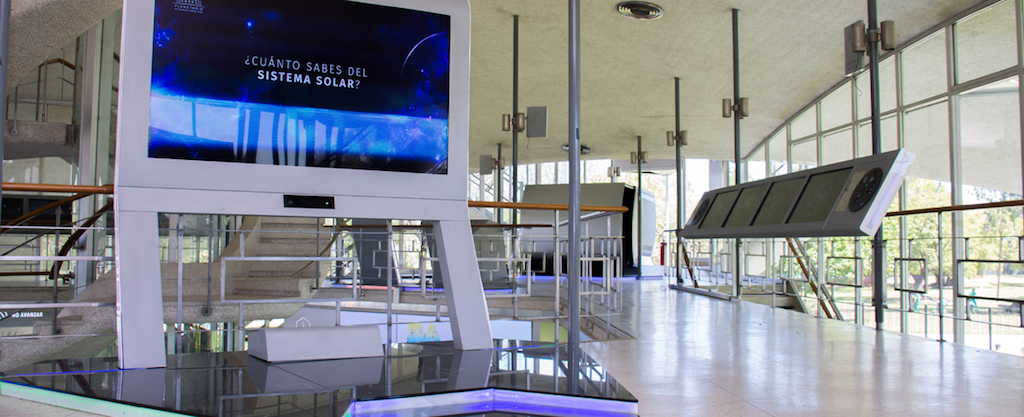
Galibot is in charge of welcoming visitors to the planetarium, that from that moment they know that something has changed in this space after its renovation and that new experiences around astronomy and science await them, such as interactive displays, astronomical simulators, augmented reality devices or a game – called Dimension Cosmos- that integrates Kinect technology so that visitors can play through their movements with the planets of the solar system and see them reflected on a screen.

For example, Two cabins have been installed to virtually recreate the evolution of the Universe from the Big Bang until now, offering during its four minutes of duration and with the help of 4D simulators, a dizzying journey in space and time with high definition images, surround sound, movements and injection of air inside the cabin.
Another area is the so-called scientific library, which has twelve touch screens on which visitors can consult (also in braille mode) information on astronomical topics, which has been structured into three groups: solar system, milky way and nearby galaxies. Added to this are the 360º Space Odyssey areas, offering a panoramic virtual reality experience with a mission to Mars, and the so-called Universe Challenge, a game about astronomy with augmented reality technology.

360º outdoor LED projection
The exterior of the Buenos Aires planetarium has also been improved after the interior renovation process, with the installation of four cross-shaped towers that surround the planetarium and that allow content on astronomy and related to science to be projected on its dome and in 360º.
This exterior projection is carried out when daylight falls thanks to the 50 meters of translucent LED panels that have been installed in the ring of the first floor of the planetarium and that work while a mapping is projected on the dome of the building. In addition, they have been installed 350 Led luminaires and a remote management system so that the Galileo Galilei planetarium is illuminated in a coordinated manner with other icons of Buenos Aires, like the obelisk, the Monument of the Spanish, the Pyramid of May or the Monumental Tower, inter alia.
Did you like this article?
Subscribe to our NEWSLETTER and you won't miss anything.