


The Eurovision Song Contest 2018 based its staging on spectacular lighting
Unlike previous editions, The stage did not have video screens or LED backgrounds., although the spectacular lighting once again played a key role. Riedel systems facilitated intercommunication and signal transport at Lisbon's Altice Arena.
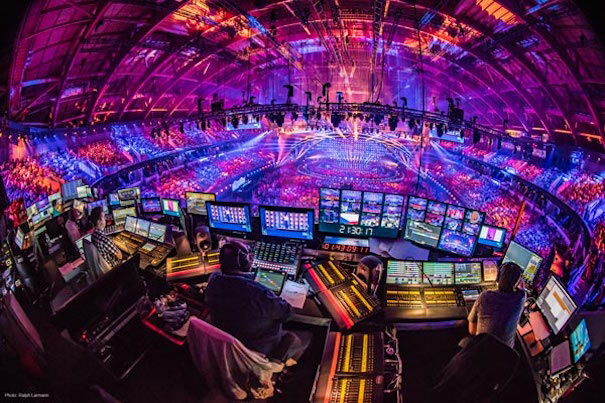
Portugal hosted last Saturday, for the first time in its history, the Eurovision Song Contest, choosing the Altice Arena pavilion in Lisbon for the occasion. Organized by the European Broadcasting Union (UER-EBU) with Portuguese television RTP as host, The great musical event opted for one of the lowest-budget sets in memory. The director of technical production of Eurovision, the Swede Ola Melzig, together with the directors of the RTP they chose to work as much as possible locally, make a good approach and use the minimum rent possible.
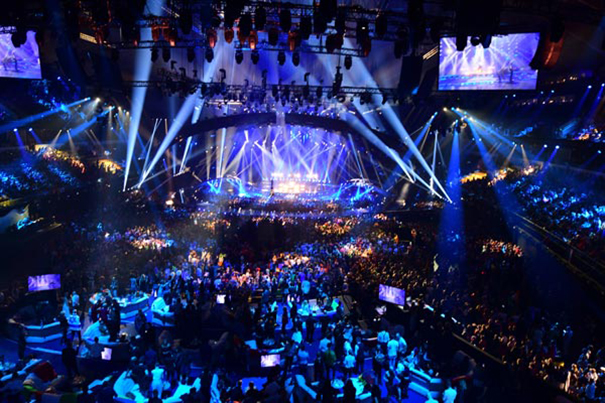
 The 63 Eurovision edition featured 43 participating countries, who performed their songs at a gala that followed 11.500 spectators and was hosted by Portuguese journalists Sílvia Alberto, Filomena Cautela and Catarina Furtado, and the Portuguese-American actress Daniela Ruah.
Jon Ola Sand was again in charge of directing., accompanied in the production by Carla Bugalho and Christer BJörkman with the Swedish company M&M Production as delegate producer.
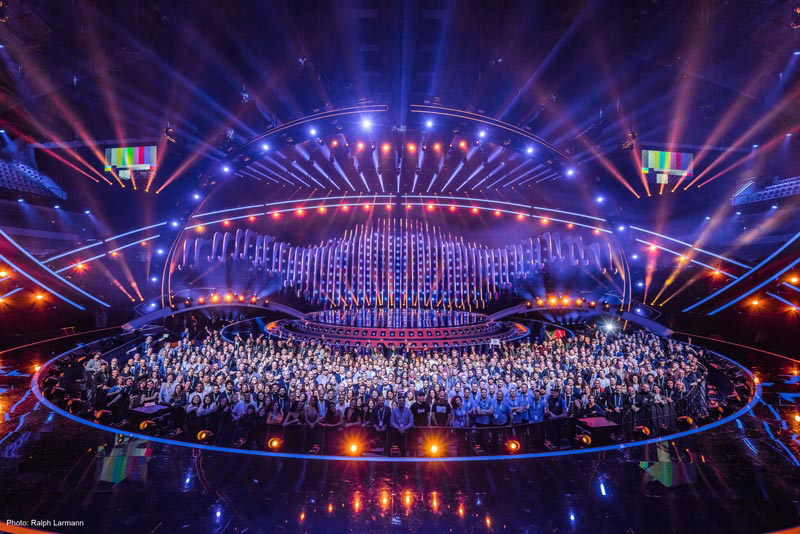
Unlike other years, The stage did not have video screens or LED backgrounds., although the spectacular lighting once again played a key role. The German Florian Wieder was in charge of designing the scenography based on three suspended structures inspired by the armillary sphere of the Portuguese flag.. The background was made up of 56 structures up to 13,5 meters high that supported 351 Magicpanel FX luminaires Ayrton.
In lighting, M&M Producciones used a total of 14 tables handling more than 152.000 control parameters and 300 active DMX universes. They also arranged 24 Follow spots controlled by RoboSpot Follow Spot System Robe. The total number of luminaires was 2.632 that they needed 24 days of programming by six operators. In lighting they were used 88 kilometers of wiring.
Regarding audio, From the roof of the Altice Arena, about twenty linearrays were suspended with 239 speakers, being used in production 232 microphones and 15 audio consoles.
As has become tradition, The festival featured numerous performances with pyrotechnic effects that were carried out by the Portuguese company Luso Pirotécnia, which also used moving flares., walking sticks, fog machines, wind, snow, Smoke bubbles… and more 50 kilos of confetti.
Intercom Riedel
In a show of these dimensions, intercommunication is key. The festival organization trusted once again in the solutions of Riedel, that deployed the Artist digital matrix and 175 intercom panels connected to a network 20 kilometers of fiber in a redundant ring topology. Each rack was equipped with a redundant power supply and a redundant CPU card. Most of all intercom panels were routed through MediorNet, the Riedel signal distribution system.
For communication between different departments, Riedel installed a Tetra-based analog radio system with half a thousand radios. This system was mainly used for production with half-duplex and simplex channel configuration.. The half-duplex channels were interconnected with the intercom system. The Tetra radio system was also used for communication with the mobile units, managers and backstage… And total, Riedel installed a base station and two remote stations throughout the entire facility, guaranteeing coverage throughout the facility..
The MediorNet signal distribution system consisted of a main routing core (6 frames MetroN Frame) and multiple “satellite” positions within the venue. Each position was connected in star topology to the core frames. Racks were equipped with redundant power supplies. Each MediorNet position had a minimum of two frames that could work separately from each other, taking advantage of all the fiber bandwidth.. In total, It was deployed to transport all types of signals over 200 kilometers of wiring.
Nearly 2.000 journalists from 80 countries covered this edition of the festival, whose organization had 750 jobs, video walls in several rooms to follow the different semi-finals and finals and several rooms reserved for interviews.
Two mobile units with an exact configuration took part in the festival broadcast.. One of them served as the broadcast signal while the other was ready to go on air in case of failure as a backup.. Both were connected through a fiber optic ring that guaranteed redundancy of the 100%. The audio mixing of the show was carried out from another mobile unit..
To ensure power supply at all times, fifteen generators were deployed with a maximum capacity of 4,4 megawatts connecting the different access points to the network with 40 km. cable.
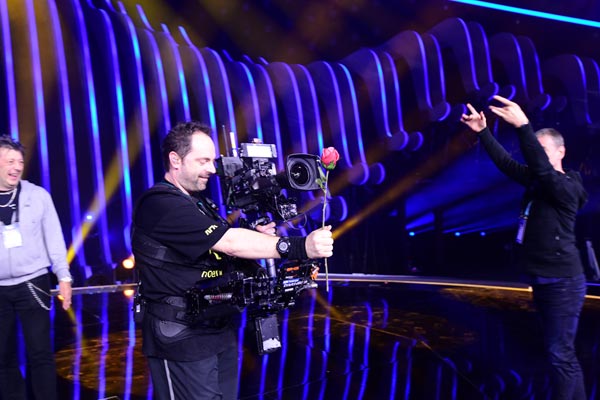
During the festival, there were around twenty cameras (including a Spider Cam suspended above the ceiling), two robotic cameras traveling around the stage, a crane with a boom 22 metros, two telescopic cranes, dos Steadycams, several drones outdoors and a technical team 60 professionals.
Did you like this article?
Subscribe to our NEWSLETTER and you won't miss anything.